

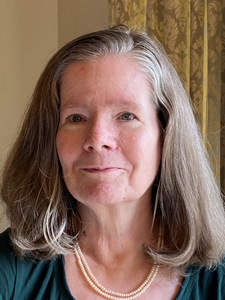
Cheryl Snell’s books include the novels of Bombay Trilogy, and poetry collections from Finishing Line, Pudding House, and Moria Books. Her new series is called Intricate Things in their Fringed Peripheries and is made of a volume of flash fiction, a collection of poems, and a novelette. Her work has been included in more than 600 journals, as well as anthologies such as a Best of the Net and Pure Slush’s Lifespan series. Most recently her words have appeared in the Gone Lawn, Drabble, 365 Tomorrow, Spillwords, Press Pause Press, Ilanot Review, Cafe Irreal, Roi Faingeant, Literary Yard, New World Writing, and elsewhere. A classical pianist, she lives in Maryland with her husband, a mathematical engineer.
Geraniums
“Shall we go see how those geraniums are doing?” My mother looks at me blankly but bobs her head as if in agreement. I push the wheelchair out to the little bricked-in courtyard where there is a small garden. There are other patients in wheelchairs set around at intervals, some of them dozing in the weak sun, others talking softly to themselves; one old lady cries for her mother. A son’s choked words can be heard through the walls: “I’ll always love you, Mom. I’ll never forget you. Thank you for being my mother.”
I position my mother where she can see more of the geraniums and fewer of the withered faces. “Look, there’s a new bloom! Maybe this plant knows you love flowers. Do you think it can tell you have a green thumb?” I playfully tug her thumb and immediately feel the nurse’s eyes on me. I lock eyes with the girl and stare until she, an inexperienced young one earning her first paycheck, drops her eyes.
*
Mom’s room is airy, the walls hung with art done by her hand— family portraits, some landscapes and seascapes. It holds comfortable, gently-used furniture, a bed, dresser, table and two chairs. The high ceiling anchors a mesmerizing turquoise fan designed to cast shadows on the walls. “See, it’s like the dance of leaves on a wall or against the sky when it’s windy,” I remind her, remembering how she loved to watch storms. Yes, she wanted storms, I think to myself.
Mother tries to lift herself out of the chair to look out the window. I help her to the window-sill, and she points to the apartment building across the parking lot. “Yes, Mom, that’s where I live. It’s so close you can probably see me waving to you.” “Really?” she says. She stands at the window and cries for a few minutes. The sight of her at the smudged glass, watching the cars retreat into an ocean of light and shadow, makes me wonder who she thinks she has lost for good, which loved one is never coming back. She doesn’t know that she is the one who is lost, a woman adrift in a drowning world.
*
A bell rings, signaling that exercise class is about to begin. “Are you ready to dance, Mom?” Dancing is what my mother calls movement of any sort these days. In this case the dancing involves a large yellow beach ball, kicked from one patient to another. Mother loves this game. One of the old men has a crush on her, and will kick the ball only to her. She kicks her feet even when the ball is nowhere near her. She’s like a can-can dancer. She laughs until she’s exhausted with laughing. I take her back to her bed.
While she naps, I make sketches of her. By now, there is a thick stack of them. When I bind them and thumb through them very fast, I can watch a movie of Mother sleeping. When she wakes up and sees me sketching, she takes the pad from me and looks at the drawings. “Is it me?” she asks. I nod, tears springing to my eyes.
*
“Do you have a mother, dear?”
I nod. A brief silence, then this: “Where is your mother?”
“You are my mother. That’s why I call you Mom.”
“I wondered why they call me that.”
“It’s because you are our mother.”
“I know, but I mean…” and she makes the universal gesture for pregnancy.
“Yes, you gave birth to me. I am your child. You have four children, and I am your youngest daughter. I’m the skinny one who had blonde bangs, and braces on my teeth.”
Mother studies my face for a long moment, and finally says, “Well, hello there! Where have you been? I haven’t seen you. Why did you leave me?”
“I never did, really. I never would.”
Mother seems to consider this, looking into the middle distance. Who knows what she really sees there. She yawns, all at once drooping in her chair like a blown dandelion.
*
Mother falls asleep again in the warmth of a sunbeam while I hold her hand. The fingers feel like old keys. Suddenly, a voice crackles over the loudspeaker wakes her. “Funeral procession for Mrs. Smith.” I groan, “Not another one,” but I push the wheelchair to the door and stand beside it. Other doors in other rooms slowly fill with patients, trying to stand at attention. The deceased passes by on a gurney, played out of this life to the accompaniment of crystal chimes. A few antique voices sing a hymn, and some of the men salute. Mother brings her bent fingers to her forehead. “Bye-bye,” she whispers.
The lobby empties and the patients fade back into their rooms. This worries my mother.
“Are the people coming?” She fidgets in her pocket for something. I know what it is. She wants to be ready for the people she is convinced will come to take her home. When she pulls out the tube of red lipstick, I take it from her and swivel up the color, a bright geranium. She’s smiling as I touch it to her lips, gentle as a kiss.
 impspired