

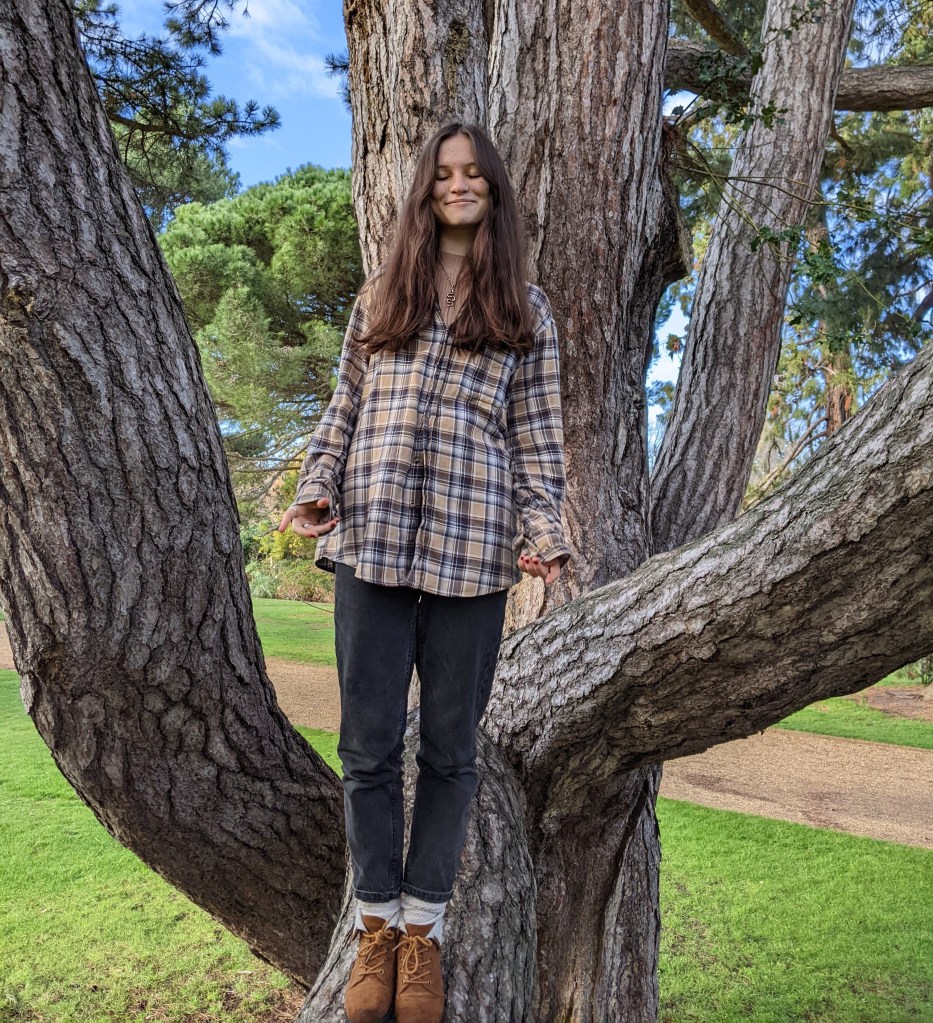
Sienna Black is a young writer from the UK currently studying English at the University of Cambridge. Her poem ‘Measurements’ was longlisted for the Young Poets Network ‘After Sylvia’ poetry competition, and her work has appeared elsewhere in Spring Journal, Salt & Citrus Zine, and CANVAS.
Wintering
It is an ordinary day that has begun beneath water. Only my nose breaks through the surface. There is no sound. Not even the maples you planted all those years ago rustle. I rise slightly, and the water yawns around me. My eyes align with the brittle grass about a meter from the pool, and I swim gently, with frogged legs, to the edge. There is a mug of tea to my right, flaked around the rim with old acrylic paint. Lifting numb fingers to the concrete, I flatten my arms against the pool edge and watch the house through the steam. A warm glow emanates from Henry’s shuttered window, bleeding dim, uneven light upon the Virginia creeper. The violet berries stare out, harsh against the scarlet leaves, and for a moment I think vaguely about crushing one between my front teeth. Staining my mouth inky blue. The toilet flushes from inside. My elbow catches the mug. I am surprised by the warmth. It feels as though the morning is trying to catch me out, step-quiet.
Sam, you’re going to catch a cold, I hear a small voice say behind me. I turn, rest my head against the hard edge, close my eyes briefly. I think about the berries behind my back, watching this.
I’m fine, Henry, I reply. He must have walked the long way round the garden; I didn’t notice.
Your lips are turning purple, he says dropping a dark blue towel by the pool edge. One corner lands in the water. I watch it soak to black, then swim underwater to the other side of the pool.
I dry my hands, face, legs, arms—in that order, as though checking they are still there—then wrap the towel around me. Now that I am out of the water, my teeth have begun to chatter. I catch glimpses of plain white sky between the maple leaves as they sway. One dislodges as I watch, lands below me. Kneeling down by the pool edge I fish it out in my palms. I run a thumb across the chalky gradient of orange to red, patchy and bright and playful. It is freckled with frost. I set the leaf down on the water. This is when I notice it, a single blot on the surface. A tumour in the maple trees reflection. A tumour, bobbing in a palely blooded sea; a grey hole against the black brain of a scan. It writhes. Dead, half-dead, half-alive—I am unsure. But every so often (though perhaps it is simply the breeze) it seems to catch against the trap of its own body, stilled by itself.
I feel a pang of something I refuse to define, cool and definite and tingling in my forehead. Pushing the base of my left palm to the spot I outline it in a circular movement, rubbing it gone. I ponder saving the blot (the fly, the drowning fly), but I have only just regained an echo of feeling in my body. The maple leaf hovers just out of reach, and I tell myself it is a lifeboat in swimming distance. I stand, walk inside, but do not lock the door.
It was summer. You were crushing herbs with a grey, heavy looking pestle. I could almost feel the sound in my jaw. A fine mist of oregano suffused the room. You smiled with your lips closed, and I watched your arms tense and release. The days were always dizzying, here. Always slightly slanted in the wrong direction. Outside the sun was sharp. The stones of the patio too bright.
I remember you when you were… you searched for the word young or younger then motioned with your hands: small.
I smiled. You nodded to the olive tree, squinting. There was more you wanted to say.
You would spend hours, watching the ants, and then you’d sit there. You laughed and closed your eyes before continuing, reaching for the bark like a person who walks in their sleep!
I lost my first tooth sitting in the centre of that tree. I must have been seven years old. It had been loosening for a week. Pushing my tongue against the back of my front teeth, I pushed a hollow into my visible smile. Let the bone fall to the ground, then lifted it before my face. It felt like a salvaging. To have lost a tooth, and still be holding it. To feel it gone and know exactly where it went.
It makes sense now, I said, that you were watching. But you had told this story countless times, and watching you lose yourself made no sense to me at all.
You nodded and brushed the collar of my linen shirt aside. This was new. I felt you lifting the necklace you made with my teeth between finger and thumb.
I was always watching, you said.
And I still believe this, though I know you are not here.
When you first became sick, I had been walking toward the two bridges by Three Bridges station. Well, you had probably been sick before this, but this is where I received your call. In the town I grew up in. As you spoke, I swear I must have shrunk for a moment. I felt as small as a child. Your voice had never been so stiff, fighting the words, the bad news, the doctors had given you. I didn’t console you over the phone. I didn’t accept it as some inevitable fact of the universe. Instead, I let a terrible silence drop like a pebble into a deep well. And the well doesn’t stop. It just stretches down, and further down. And there is no water. No ground.
You ended up consoling me.
A few years later (we were lucky), I found myself there again, wandering in the aimless way of someone who is far away from themselves. The sound of trains above me brought me back, for a moment. They say life flashes before your eyes—brings you back, for a moment—before you die. I can’t help but wondering how it was for you. London Bridge is falling down,
a busker on the street, tossing coins from his own pocket into a guitar case that is
hard and scuffed like a shell; the felt so red you could kill on it. I promise
falling down,
no one would notice. A man is shouting across at a woman
he seems to know. Her puffer jacket brushes my cheek as she walks past us;
I am, was, that small. I feel, felt, so small.
falling down. London bridge is falling down,
A holler of feet trampling down the piano keyed steps of the tube. My fair lady.
Listen, you had said. Because you did this, you used every sense in your body to watch.
To what? I had asked.
To all this sound. And these days I think you meant life. But the doctors say the tumour could have even been forming from that point, and English was already your second language.
What’s he doing? I asked as the woman rushed past us, so close I could almost taste her fear.
You just shook your head. You are dead.
Back in the house now, I find myself half asleep to the smell of my hair lightly burning against the radiator. (I live my moments in halves: half-dead, half-alive). I am wrapped in the blanket you knitted for me before your hands were arthritic and gone. My own hands clutch it now, close to my skin, and I am trying not to think of your mouth and how it caved in when the doctors took your teeth. You couldn’t seem to close it; you seemed to try in your sleep to close it. And the teeth they stole weren’t even yours anymore, and there is no necklace to keep. And, oh God, you were lipless. Pale skin, palely rising day, blot on the palely rising day reflected in a waterlogged hole in the ground. Lips losing colour in death. The maple is mocking you. In this very moment, the frost is freckling a leaf. Here’s what I am trying to say: I am always trying to close your mouth. Yes, in every second. Here’s how I do it: I push your lower lip up with three fingers under your chin. Here’s what happens: it flops open like a puppet, or a fish. You resume gasping. I cry on the floor by your bed, holding your hand, your hand so cold and stiff I fear for your life. My limbs so stiff and cold I can almost taste my fear for your life on my lips. No lips. Lipless. (Adjective, lacking a lip or lips. Synonyms: unlipped.) Maple trees are a fire dampened in chlorine. The doctors tell me to drive home, get some sleep, you will still be here in the morning.
I don’t want you to exist in my mind as being only good. I want to have memories of your scream, of how you would throw a glass and watch it shatter, of your face closing in anger: but in this volatile family, you were one of the good ones. It is so cold on this floor, so warm on my back. I forgive you; you were only good. The doctors told me to drive home, get some sleep. I never heard your heart stop beeping, just the shift of sheets beneath me. You were alone when you died, your mouth was open, you had no last words for me and no teeth either. No smile. You left me with nothing. You were only good.
Virginia creeper isn’t completely poison-free; its berries and leaves can be harmful. The berries can cause irritation to the lips, mouth, tongue and throat if consumed and may even cause difficulty breathing if the mouth and throat begin to swell—but this is RARE. In fact, we(bsites) strongly advise that if you find someone who has eaten Virginia Creeper leaves or berries, do NOT panic. A man on the internet says it tastes a bit like a grape, a woman on the internet says she bit into something with such a non-grape flavour that she realised it must be something else, the Misourri Poison centre say to call them right away. Do NOT panic, they are probably just checking in. Who writes all this? It is called a Virginia creeper, how did it get here? In addition to Virginia creeper, it has got some other names, such as: […] false grapes. I’m starting to mistrust the man. The FDA cites a report that a child in Oregon became violently ill and died after eating a large amount of Virginia creeper berries. And did you know, there is no (dedicated) Virginia creeper helpline? My panic would have you rolling on the floor. But be careful with that because the FDA also reports of some children collapsing into a two-hour stupor. What do the berries do to a smile? Be sure to wipe out the mouth with soft, wet cloth. If the child is able, have them swish water in the mouth and spit out. The mouth, as though detached from the body.The child, as in the only one hurting. You were never a child when I knew you, did you ever know this?
Sam? Henry asks. My name, now a question. He still won’t call me mum, but we don’t fight about it anymore. It’s starting to make me like my name. He bends it in the middle, with the deliberate care of a child trying to speak: Sa-am. Sa-am.
I close the laptop, push the base of my palm to my forehead then look up at him. He sits where I once did, and I stand where you had. There is no blinding sun or crushed herbs, though. It is winter, and there is no you. I lean forward and take his hands in mine. I smile.
He half-giggles, half-squeals at my touch, says, your hands are really cold Sam. He turns them over, points, says, look!
My palms are red and blotchy. Sorry, I say.
It’s oh-kay, he says. And his words are staccato and bright. What’s the matter?
I was thinking about my Granny.
Do I know her? He asks, kicking his legs back and forth on the stool.
You only knew her briefly before she moved out here, I say. I pick up the kettle and cross to the sink to fill it up.
Why isn’t she here now, then?
Setting the kettle on its base, I flick the switch down. Tea?
Mm, okay. He pushes out his lips, suddenly bored. Then, brightening: is she nicer than my granny? Can I meet her?
I don’t know what to say to this. The house is crowded with questions of late, and I have never been one to hold answers. My instinct is, and has always been, to turn to anyone outside myself. Now it seems all I am left with is myself. All I am left with is soft spoken conversation. I tread so carefully around your absence that sometimes I fear I will forget how to walk. You only knew him swaddled and wordless and bald, but here he is alert and waiting, and only now do I have questions of my own. Like, how do I cut his hair? He has a head full of it now and it grows far quicker than I am used to noticing. Years have passed. Surely, I should be used to all this by now. Your old house is so quiet so often and I cannot fill it alone. I pad across the kitchen and pour the lukewarm tea from my mug, scratch a flake of rainbow skin from the rim, leaving the paint satisfyingly injured. I could scream right now; I could terrify. Silence returns to the air. The kettle has boiled.
I turn around with our mugs, and then find myself laughing. What are you wearing? He sits hunched in his chair, blue dressing gown on (the one with white and red rockets, travelling to various stars and asteroid clusters), and beneath only swimming trunks.
I was coming out to swim with you! He says defensively.
Noticing the goosebumps on his skin I walk round the kitchen surface to wrap his dressing gown closer around him. Thinking about it, I don’t think you knew of this dressing gown. I think it came afterwards. You drew a line in my life.
Here, tie the belt, I say.
You tie it, he mumbles grumpily. So, I do.
Do you want me to get you a jumper? I ask.
Yes please.
When I stayed with you the weekend before it was time, unlocked the door, and walked through your house, this house, I made note of every memory. I made note of every memory and promised to make more, as if you weren’t on your way anywhere. Then, I saw you.
You were sat, wrapped in a blanket, on a deck chair on the patio. Half in the shade, half lit by sun. Someone had cut your hair but judging by the way your hands shook, it was not you. You loved what little hair you had left. If you had had the strength, you would not have let them near it. For the first time stepping foot into this place, there was no slant. It all suddenly felt certain.
Hola Abuelita, I said quietly, pushing through the door. You turned and looked at me for a long time. Then, you stretched out your hand to hold my cheek for a moment.
I once knew a girl who looked just like you, you said.
Tell me about her, I said, swallowing the clogging breath in my neck and shifting lower into my seat. Overcome by an urge to shelter.
Oh, you said, a warm smile reaching up into your cheeks. Where do I start?
At the beginning. I tipped my head back, closed my eyes, and waited. There is something about real that is too much to bear, always. So, it seems, you softened the blow in your forgetting.
Well, right from the start, mi amor said ‘there’s something special about that girl’. We knew she was going to make us proud… You spoke for some time, merging the stories from our family into one, painting a far nicer picture than any of us could conceive on our own. Impossible things, like brushing my hair when you were a little girl. Or embracing my mother on your wedding day. In your mind, at that moment, you believed with all your might that you had known us always. When you finished, when you had run out of words, or forgotten them, you gasped suddenly.
I opened my eyes to see yours widen. You said, oh, mi niña! It is you!
I helped you from your seat, held your arm in mine, kissed the top of your balding head. We walked into the kitchen; I sat you down on the stool. Searching the cupboards, I found them to be mostly empty. Except some alphabet soup.
Has your carer been round recently? I asked you. But you were far away, running your nail down the grooves of the place mat before you. Looking to you, then down at the can in front of me, it almost felt right, if not enough. Perhaps old age is just this: a painful return to childhood.
When I placed the bowl in front of you, and you looked up with that clear eyed gaze, I could tell I had receded from your mind again. Come on, you should eat, I said gently.
You picked up your spoon, pushing it slowly into the bowl. Then, lifting it to lips, you said, I don’t like—I am not hungry.
But as I watched you gulp the letters, I said: well, it’s a beautiful day to eat our words, at least.
My words:
I want to know what it is to be held. Not held down, not caught in a moment that ends because it must. The face closing in anger; the glass as it shatters. All of this must end. It is best I never told you this, but I saw you. Through the crack of a door the colours of her rage could not think to close. Your hands froze in front of you. You did not know where to place yourself. You turned away. Sometimes I whisper to myself: I need to stay intact. Did I ever tell you, or did you know before I ever could, how dad cries every time Walking in Memphis plays in his car? Sometimes I whisper to myself: I want to bite down. Stain my mouth inky blue. Too much has happened, without question. And I would put out the light, as if to put out the voices. As if unseen targets are not still lunged at, if a little more blindly. There were many mornings after. After the storm, there is also quiet. All of us eating breakfast in silence. We would not look at what we would not speak of; we would not meet each other’s eyes. But this once, it was different. You were talking and talking loud to show your smile. And it mattered. It matters. But do I really feel the way I feel?
Your words:
I fear my bus will never come. But I do feel the sound of the road in my stomach. And when the bus arrives (as it does, as it does) I sit close to the front. I watch raindrops travel uphill on the dash; something about an image and how it changes in shadow. There are still stains on the glass from where people have touched it. Echoes of touches. We are here. Can you hear me, child? Briefly, we are here. He and I were tripping through the door when we knew it. That touch, as when you reach out to be touched by the light. I pictured us in old age often, keeping occupied. All was well. We ate well. Slept well. Tried, well, give it time, give us time, and all will be cheek graze and touch lip, and whispers in the dark of something so much bigger than us. Now, can you hear it? Listen. People will strike, to break the silence. All is loud and getting louder. All is quite. All is alright. All is so little if we think of it.
Now, I am sitting very still to make my world appear small. Nobody likes a woman who has been.
I can’t remember where I have been.
All is very quiet.
 impspired