

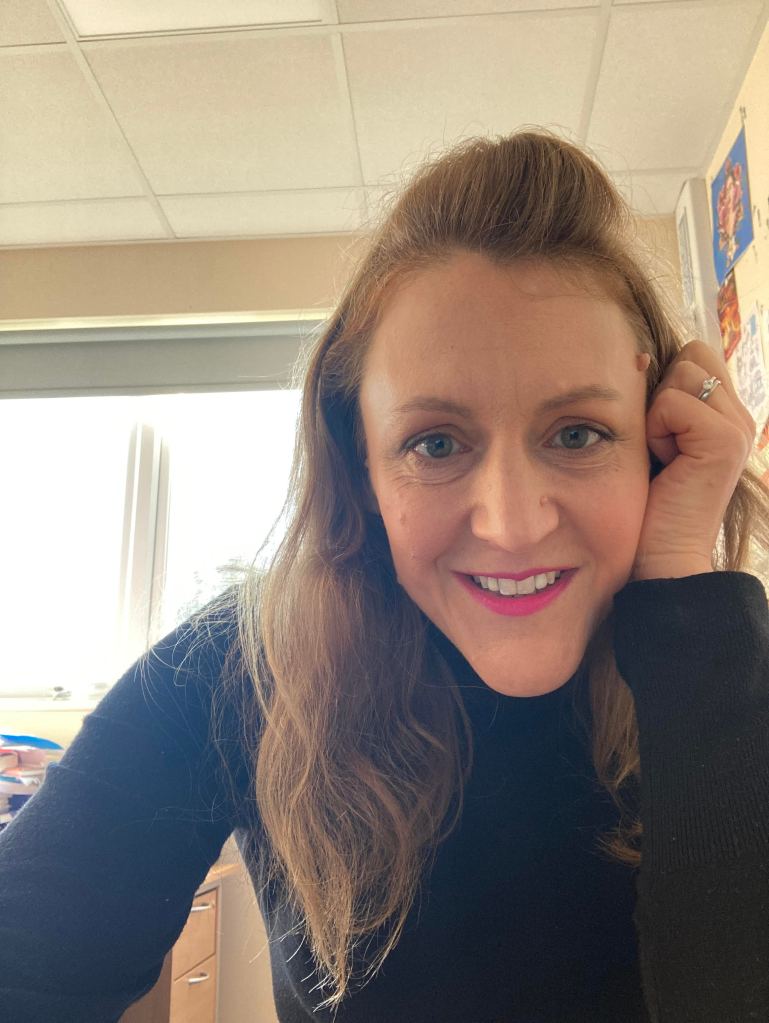
Leah Mullen is a New Jersey native who’s been living in the UK since 2003. She is a secondary school English teacher and advocate for the arts and humanities subjects. You can find her work in Five on the Fifth and an upcoming issue of Molotov Cocktail, and she has been shortlisted for several flash fiction awards, including the Bridport Prize.
Coney Island Ghosts
Beth worked the Coney Island Cyclone the summer she turned twenty five. Old enough to
know better, to have to smoke alone outside the breakroom because really smoking’s only for boomers; young enough to secretly enjoy the whip of the coaster’s path after a shift and spend too much on funnel cake and hot dogs.
Beth worked the Coney Island Cyclone in her mom’s cutoffs from the 70s and she always carried her dad’s lighter in her back pocket. Some weekends, the shorts helped her hold on to her mom’s memory. Others, the lighter came into her possession from her Dad’s personal effects after a flight with a disastrous ending. Some weekends she just Cycloned over and over because it was easier than chitchat in the breakroom. Like the weekend she slept with Jaysen, who was 20, and told her afterwards he’d done because he wanted to “ride a piece of history” which was a fantastic Cyclone slogan joke that she giggled at a few hours later. Her knuckles still hurt from the hole she’d put in his plasterboard and she swore she could still feel the soft give of his flaccid dick against her driving knee.
Beth worked the Cyclone the summer she decided to cancel her twenty-fifth birthday party due to lack of interest. It’ll be at Place to Beach! The beer-topped margs are bussin! The invited breakroom girls flicked their glossy manes, said thank you and nothing else.
Beth had been worked over outside the Cyclone early one morning for her phone and wallet under the eye of a walnut-wrinkled man in a beanie who as far as she could tell afterwards through sticky eyelashes and with a blossoming concussion was eating a Nathan’s wrapper. She tried to explain what happened to her mom. Her mom told her she’d look much prettier if sheAt work the following day the girl who once complained of a crick in her neck from taking too many downward angle selfies and giving too many blow jobs whose name Beth could never remember because it was Kelsey or Kacey or Kayla was the only one in the breakroom. Her glance darted over Beth’s bruises and she made a Yuk face and an awkward noise and no more was said about that in the Breakroom.
Beth worked the Cyclone, but when she was up too early she’d come just to stare down the sickly eye of the sturgeon moon as it tried to escape her past the pier and into the Atlantic. Behind her, she could feel the coaster, imagine its delicate lattice as a tattoo across her back. Its every bank and u-turn, its camel hill, its brake run, the sound of its creaks and screams, the silence in the spaces left by the dead who’d run afoul of the Cyclone across the decade, the the feel of flaking paint under her nails…the familiarity of it, the comfort of it, made her stomach clench and roil. Really, she should’ve made something of herself by now.
Beth had worked at the Short Hills SoulCycle as a Team Manager the summer she turned 23, but she hadn’t gotten along with the Team that she Managed.The breakroom girls and boys took lunches to not eat and hunch their back against her and she had an MBA from UConn and really was good at telling people What to Do and getting people On Side and Leading from the Front but at 7pm she’d watch them calling shotgun like highschoolers and riding out in the muggy August gloam to god-knows-where.
Beth had worked it out: Jaysen was on the Cyclone that weekend. And Breakroom Girl with the K name was too, on Belts & Safety, leaning over a grinning cargo of boys, flicking hair loosed from the band she’d lent to Beth, all seventeen and golden summer and seasalt, hair flicking, flicking. Beth dropped her phone; Breakroom stooped to retrieve it. Beth gave Jaysen the ok.
The Cyclone pitched forward with a bony shudder and Breakroom stumbled onto her ass. She crabcrawled along the platform, attached to the last car by her hair,and in her eyes was confidence that everything would be ok because everything always had been. That and panic.
But the Big Cyclone Drop was approaching, just after the lift hill. Now she clawed at her glossy mane, bobbing just below Jaysen’s sightline, and anyway he was staring at his phone to avoid Beth’s poisonous gaze.
Beth’s great work that summer was the nonchalance she exhibited swinging a pale leg into the back seat of the last car of the Cyclone. She might have been crying, or squinting in the unforgiving Atlantic sunlight. Out they all swept, Beth, and the girl, and the tourists, and the Coney Island ghosts, onto the sinuous, uncompromising track of the Cyclone where Beth worked the summer she turned twentyfive.
Heartwarming Stories of Inspiration and Acceptance Can Take a Hike
“Can you backflip in your chair?” he asks me. “Like, is it one of those…stunt chairs?”
Generally I don’t mind this sort of question. At least we’re talking, not just pointer and pointee. But I’m not above fucking with this guy.
Since moving out on my own– late, but not later than my peers stuck under fairy lights and Taylor Swift posters – I have had a Life Improvement List. It’s had various titles over the years, been stuck under stacked admin and crockery I meant to wash up, before surfacing, piquing my interest, eventually burrowing again. It was never designed to grow.
- service dog
- local bar playing two-tone, ska will do in a pinch
- wheelchair volleyball team
- men’s hairdresser who will buzz my undercut for cheap even though I am not actually a man
- ramp into Vintage Sally’s so I can give them all of my money
- CBD oil but it has to actually work
- drum lessons
- 500% increase in accessible state park trails
- 500% decrease in viral videos of pugs with hind legs in a wheelchair making kissy faces at “regular” dogs to symbolise Inspiration and Acceptance
In all aspects of my independence, I am a well-oiled machine…in a well-oiled machine. Routines are honed and no further input is required. And I’ve worked hard.
A few months back, Corey started training my new assistance puppy.
The puppy is great. Eventually, apparently, he’ll even be able to give my bus pass to the driver if I drop it. So far, so good: the list shrinks.
But there is no bullet-pointed space for Corey’s whitewater tan and mountain echo laugh, . The chaos should make me anxious.
As we train Alexander (“not a dog name,” Corey asserts, so I say I will give him the full name Alexander the Great and he can grow into it), we roll and we walk the needle-scattered trails of Island Forest out in Great Basin, on which we’ve spent hours together as spring has ignited summer.
The forest path is deepening in sunset shades. Corey is either admiring my chair or my undercut.
“Backflip?” I kid. “Sure. Watch.”
He waits: tousled, beautiful, idiotic against evening firs.
I do nothing.
With a penitent and wicked smile, he kneels for a fetching stick. Whips it smoothly across the forest. Parts of me are doing backflips.
“Just – you look like you could do stunts. Strong. And crazy.” The zipper on his jacket suddenly deserves intense attention. “My friends and I are going out Thursday. You busy? Or?”
“Or,” I tell him.
“They’ve just done up the old Renegade Taphouse. New band’s playing tonight. Called Ghost Townies. Tribute act I think. Should be kinda punk.”
“Two tone. But yeah. Count me in.”
My list shivers into dropped pine needles, and I roll on over it.
Seventeen Years
New Year’s Eve dawns on melting roads. Tires sludge through asphalt past the ski resort; Abby notices little brush fires crackle in the dry grass under the chair lifts through the insect smear of her windscreen.
Avoiding these– but barely, listlessly – the heat refugees cross the slopes. Their necks are slack. Babies in wraps loll. Preteens catch their widelegged jeans in the embers and pass fires on to patches of waiting scrub further along the path they’re cutting.
On they push in their hundreds. Towards trees, or water.
Without cover, the air sledgehammers your breath from your chest.
Seventeen years ago she breathed in air so cold it sparkled in her lungs as her cousin drove her wildly over frost-rimed roads past these same slopes. The heating in Zack’s car was on the fritz as usual and one of the windows was stuck open; she huddled next to the others in the back seat and they sang ridiculous radio songs into a night like a frozen lake and they watched their breath stream behind them and imagined their voices echoing off the hills and chairlifts.
The memory feels almost false today. The family at Mom’s funeral bear no resemblance to the shrieking kids she drove around with during high school Christmas vacations. Her cousin Zack is blanched and paunchy now; not well-fed but more like he’s expanded in the heat.
“Think this new fence’ll keep em out?” he asks. He waves to the chainlink that’s already burnt a toddler’s hand and it’s not even 11am. “Seems to me they’ll just push right through it.”
“They’ve done research says that they change course when they encounter obstacles,” Abby tells him, wearily. Everything is weary now. “I’m not worried.”
“Seems to me something should be done.”
“Seems to me something should’ve been done. Before.”
They all mop their brows and extend sweaty handshakes, and then that’s it, and their cars line up at the gate to make an escape Abby doesn’t have the privilege of..
Back at Mom and Dad’s, the afternoon outside is insensitively bright around brand-new blackout blinds, as if to celebrate new beginnings. Her mother loved January for its stark monochromatic poetry; she would have hated this.
Each chipped piece of her mother’s disaster-prone willow pattern set at the sink sets her off in reveries. She fingers rough chipped edges, presses her thumbs onto the jagged cliffs where tea cup handles abruptly terminate.
She is listening to the cicadas.
The sound unwinds something tight in her ribcage. Rising and falling, persistent, the hum of summer breathing. A ribbon of longing, which had long been knotted and strangling, unravels and floats gently towards her solar plexus.
“There are no good coupons in the paper anymore,” her father mutters into coffee which, in years past, would’ve gone cold by now. “Or maybe it was just your mom’s sorta coupon magic.”
On the waxy tablecloth he rests elbows whose tattoos have blued into meaninglessness. The print he scours is blotted by great gouts of his sweat. “These are ration coupons, Dad.” She moves the small camplight so he can see in the dimness.
He looks petulant. She turns away and wipes her forehead on the damp sleeve of her mother’s old cheesecloth peasant blouse: the one she’d saved from her father’s numbed purge of her ephemera.
Still nearly a child when she’d left this house, what she’d come back to was dangerous in its uncanny resemblance to normality. You could get lost in the polish of the sideboards and the smell on the corks of near-finished vermouth bottles Dad had forgotten about and the sweep of ceiling fan blades. You could convince yourself to be painfully careful putting the Hornsea wedding set back into the china hutch, just exactly as though it mattered. As though anything mattered anymore.
But she could allow herself the cicadas. They’re still here; we’re still here. Like some kind of chitinous bellwether. And at least I’m home.
Her father’s chair suddenly squeals on the linoleum. He grunts, “When you die, what do they do with your air miles. I’m sure Mom had a ton.” He sets his jaw. Slaps the table, with malice. “I can’t wait this out another goddamn minute.”
“Dad we’ve been over this. Where are we going to go? Where is there even to go? You know even when I arrived they were closing the airp–”
“You got to go somewhere,” he says. “Your mom got out. I been here seventeen years on my ass. And they’re coming.” His voice takes on a weary significance, but not fear. “You’ve seen em.”
She doesn’t respond. Comes to sit in the chair he’s just vacated and studies the light insinuating itself around the rags clogging gaps in the kitchen door frame. Somewhere in the past it slams still, and summers spilling over with cousins and freezepops and lightning bugs repeat on an infinite loop.
Fleetingly she has the childish thought that if she doesn’t breathe, makes herself invisible, he’ll forget this stupid idea. But she finds that she can’t hold her breath. The ribbon round her lungs, once loosened, refuses to resume its stranglehold. Maybe for good. Even her father’s discontent weighs on her deliciously like the terrible woollen cardigans her mom used to knit. All of it – the heat, the migrating masses, the losses – seems to slick off of her damp skin and get lost under the sound of the cicadas.
“You had your seventeen years,” he says. “I’mma pack my case.”
He rises and quits the room, stiff and sullen.
“But it wasn’t seventeen years,” she calls after him.
No, it was sixteen-and-a-half. She’d left home clutching a freshly-earned university diploma with four more years of study ahead of her in Ireland. And she’d been caught abroad – rent, job prospects, research, men – each year entangling her more thoroughly, until coming home seemed like a beautiful impossibility.
Now, as her father bangs drawers above her head, she is finding room for souvenirs of her travels and framed prom scenes. She is packing away the sugar plum houses and plastic gingerbread displays her mom had only just decorated with the week before she died.
Some of the girls in the high school photos
are gone now; caught out by treatments too-long postponed since the mass of boiling bodies had started welling up in ambulances and multiplying in waiting rooms.
She would be there for the rest of their funerals, she decides.
Abby strains to listen for the telltale shuffle of the inexorable march of the nearly-dead. But outside, all is quiet, apart from the throb of the insects. Inside, the comforting dimness and cool of the kitchen is almost audible.
She fills her grateful lungs with the scorching air of home.
 impspired