

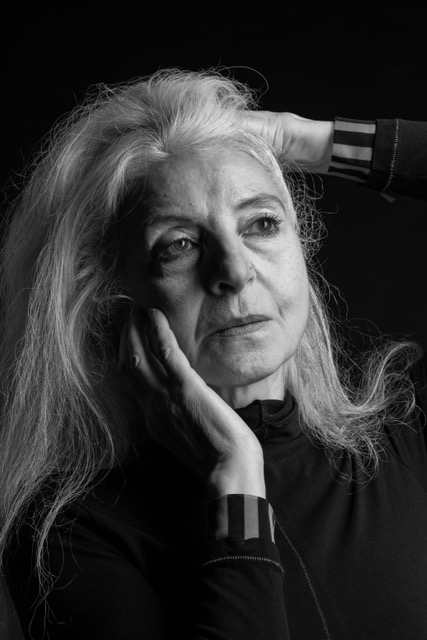
Alex L.R is a former university lecturer with a PhD in Art History and Archaeology from SOAS, University of London. A fashion activist committed to diversity and inclusion and greater visibility of older women, Alex has blogged, written for magazines and journals and is the author of books on fashion published by Bloomsbury and Rizzoli New York.
The golden chain with the amethyst pendant
Summer of 1976: I was nearing the end of my first year at the University of Siena, reading modern languages with French as my major. By the start of the second semester, the eager fresher that I was had become a disenchanted student who hardly ever attended lectures. Tutors barely acknowledged me; when I encroached on their paths there were always blank looks and absent-minded nods. In class, on the rare occasions I showed up, I never spoke, fearful of saying the wrong thing and coming across as dumb.
My days were spent reading and daydreaming, hatching secret escape plans. I knew I would breeze through the upcoming French exams; I spoke the language fluently, thanks to my mother, who every so often would throw some French at me and my sister. My maternal grandparents, from Tricase, a village in Salento, had migrated to Switzerland soon after the war. They sought a better life for their children in Geneva, the chosen destination of many Italian migrants. Without much formal education but with a strong work ethics, my grandparents eventually set up their own catering business.
Mother was just a little girl when she moved to Geneva and grew up speaking Salentine dialect at home, weaving it together with French. Father, from Bassano Romano, the only son of a family who had made its money selling furniture, crossed paths with her during a trip to Geneva, where he had gone to visit relatives. Love-struck, he proposed within a few weeks of meeting her and Mother, ever the romantic, dreamed of a glamorous life in Rome. Little did she know that Bassano Romano – a sleepy provincial town in Lazio – was nowhere near Rome, despite its name.
I shared with three other girls an apartment nestled in a verdant enclave, beyond the walls of Siena’s historic centre, where rentals were prohibitive. My flatmates were a bit older than me, which made them seem very sophisticated to my eyes. We had a phone installed in the hallway, a parental mandate so that they could easily reach us. One of the girls, Lola, a law student, was from Vibo Valentia, in Calabria. Her mother’s calls punctuated our daily routine. She would phone, without fail, first thing in the morning, around 7 am and then again at 8pm. Lola came home in the evening from wherever she was to take the call, then went out again, sometimes not returning till the morning, in time to pick up the phone when her mother rang.
Once a month I would reluctantly travel to Bassano to see my parents and younger sister , though sometimes I would skip the visit, under the pretext I had to study hard. I felt too grown up to be running home to my family all the time, I had turned eighteen in early January that year. We celebrated my birthday in Bassano, where I had gone for the long Christmas break, and I was allowed to drink a glass of prosecco, because at last, I was an adult. Mother gifted me a gold chain with a small amethyst pendant which was a family heirloom. It soon became my cherished talisman against stress and sadness: my hand would go to my neck and touching the stone had become a soothing ritual and a source of solace.
My parents expected high grades from me. In their eyes, studying in Siena was an extravagance, but I had insisted, I wanted to get away from Bassano at all costs. Even so, they loved telling everyone that their eldest daughter was at Siena University because of its international reputation; it had a nice ring to it.
I totally lacked the courage to tell my parents about my plans: after those French exams, for which I was sure to get a top grade effortlessly, I would go to London “to improve my English before the new term” I would say, but that was an excuse. I would not return for my second year. London would become my base; I would take up odd jobs – waiting tables, babysitting, cleaning hotel rooms, that kind of thing. I would learn English thoroughly, for I barely spoke it. Then I would travel around the world. Asia first, I so wanted to go to India. Then Africa. Then Australia. There were so many places I wanted to visit!
My flatmate Lena, already in the third year of a degree in Social Sciences, was a political activist, a member of the Radical Party, always shuttling between Siena, Florence and Milan to stay connected with larger cities’ happenings. In those days leftist political groups heavily recruited students, who could get mobilised in the blink of an eye. There were endless discussions and occupations at university; we were fighting for a better world and resisted the “system.” Sometimes all the talk about “autonomy” and “alternative lifestyles” overwhelmed me, but to admit it would have embarrassed me.
The Radical Party, led by Marco Pannella , had petitioned for divorce in the early 1970s, and was now campaigning for the legalisation of abortion. Terminating a pregnancy was still a criminal act in Italy and unsafe backstreet practices were rife. Feminist collectives and activist groups rallied around Pannella in support of the pro-abortion campaign; like many other young (and not-so-young) women, I too was sympathetic to the cause.
Lena invited me to help organise groups travelling to London from Florence, where a large collective had links with the Mary Stopes clinics. The women gathered in Florence and usually went to London by coach on Sundays, returning the following week. The terminations were performed at affordable private clinics run by or connected with the Mary Stopes charity. I was happy to be called upon to contribute even though I only performed menial tasks. It made me feel valued. Naturally, my family knew nothing about this, they would have been horrified. Both my parents were staunch Catholics and deemed abortion to be murder.
Mid- June arrived. Exams were about to start, then the majority of students would disperse until September. Siena in summer always attracted hordes of tourists; preparations for the annual “Palio” were in full swing.
One late afternoon, as I was lounging on the balcony with an ice-cold lemonade, and doing my nails, Miriam, whom I only knew by sight – we had met socially but never talked much – turned up accompanied by her boyfriend. Trouble loomed from the moment they arrived. Still in Liceo, tall and shapely, Miriam looked a good deal older than her 17 years, perhaps because of the heavy make-up she wore. She towered over me, even though I am not short. It made me feel uncomfortable.
Dudi, her boyfriend, was a few years older than her – us – and was supposedly studying architecture in Milan, though it was common knowledge he had dropped out. He drove a flashy car and was from a well-to-do family who lived in Florence. They owned property all over Tuscany and a luxurious apartment in Siena, which Dudi shared with his older brother, a research assistant in the Department of Law, tipped to become one of the youngest professors at the university.
“Ciao” said Miriam “sorry to barge in like this”, though clearly she was not sorry at all. Dudi mumbled a greeting. Handsome, I had to admit, but a bit too stocky for my liking. “I need to ask you a favour” she continued, lowering her voice – Lola’s parents were visiting from Vibo. Not that anyone could overhear. Laughter and the aroma of cooking wafted in from the kitchen – we would be eating soon. Lola’s mother, whenever she came, always brought us Calabrian delicacies not found in Siena and cooked mountains of food to last us weeks. “I know you and Lena are involved in the pro-abortion campaign” Miriam continued. I stiffened. Were they here to threaten me? Dudi was known to be right-wing. She hesitated a moment then blurted out “I need help”. I knew immediately. I scrutinised her face, detecting a hint of anxiety, but I sensed her determination. Dudi stood by silent, looking away, somewhat embarrassed. “Let’s get out of here” I said shouting to no one in particular that I would be back soon and adding in a playful voice, “Please don’t eat everything; leave something for me”. “How far gone are you?” I asked Miriam quietly on the staircase. “I am not sure” she replied “I have missed two periods.”
There was a café round the corner that made delicious gelato. I fancied one but did not want to waste time, we needed to talk in private. Climbing into the back of Dudi’s car I informed Miriam about London. “The clinics are excellent” I reassured her “if you fly it will be quick, just an overnight stay.” She looked at me, in disbelief. “It’s out of the question, I am not eighteen yet”. Of course. She needed parental consent for the procedure, the London clinics were very strict on this point. “I have to do it here. That’s why I came to you. I do not know Lena too well” she began to explain. You do not know me either, I thought, but stayed silent. “Can you recommend anyone?” she asked, calmly.
I do not know what possessed me; I could have– should have – declined to help, but instead I promised to find out. “Please” she implored, grabbing my hand, on the brink of tears. “I have to do it soon. I am having morning sickness”. Dudi lightly kissed her cheek. “We can get married and have the baby” he offered, not sounding very enthusiastic. “Absolutely not” she replied, “I am not ready.”. I found it surprising, I assumed she would have wanted to get married. But I did not delve further. Now I had to deal with this unexpected and bothersome situation that I had been dragged into.
Finding someone was not difficult. Lena discreetly passed on the address of a certain Signora Colombo, a midwife who lived close to the hospital in Santa Maria Scotte, where she worked during the day. “She is one of the best but not cheap” Lena warned. I called up the Signora and made arrangements, using coded language and omitting Miriam’s age. Signora Colombo charged the equivalent of today’s €400, cash-in-hand. It was a considerable sum for us, even for Dudi, who had no ready access to cash, despite his family’s wealth. I asked Signora Colombo whether she could give us a student discount; she chuckled and instructed me to pay upfront. She would see Miriam the following day. “Don’t be late” she added before hanging up. The next morning Miriam skipped school and, with Dudi, came to pick me up in his car. We met by the café, which was still closed, away from the prying eyes of my flatmates, even Lena. Dudi drove us to Signora Colombo’s before she began her hospital shift.
The consulting room was spotless and smelled of disinfectant. I handed the midwife the equivalent of €200, reassuring her I would bring the remainder by the afternoon at the latest, even though I did not know where I would get it. “Take this” I said, removing the gold chain with the amethyst from around my neck and placing it in her hand “as a collateral.” She accepted it, silently.
After examining Miriam, Signora Colombo declared that she must be three to four months pregnant. “A bit late” she added “but I can still do it. Shall we proceed?” It was a rhetorical question. Miriam kept still as the midwife inserted a small plastic tube in her womb. “This is the hospital number, Department of Obstetrics” Signora Colombo said to me. “Call me at once when she begins to bleed. I reckon it will be in a couple of hours”.
Outside, Miriam complained of being in pain. We were not far from Dudi’s home and drove there. Dudi’s brother was already at work but we had to wait in the car for the Filipino cleaning lady to leave, to ensure no one saw us go in. In great discomfort, Miriam could hardly walk. As we entered, she squatted on the floor in the hallway, bleeding. Her dress had stains which kept growing larger. She had not thought of bringing spare sanitary pads; Dudi went to fetch some towels.
Sensing something was wrong I rushed to the phone to call the hospital. I could not reach the midwife, so I left a message asking her to call back urgently, repeating the number twice, and pretending to be a family member. Time passed and Miriam seemed to be getting worse. I panicked. “Should we take her to A&E?” I asked Dudi. It was not far, we could even walk there. “They will arrest us” he said, gloomily. “We can’t let her die, she needs medical attention” I snapped, deeply regretting my involvement. The bleeding terrified me, I had never seen anything like it. I was afraid.
What could we do? Now lying on the floor and moaning loudly, Miriam seemed in agony. Dudi gestured to hush her. It had not been two hours since we left Signora Colombo. 11 o’clock. No call yet. Miriam was as white as a sheet and very still. Was she dead? “Enough,” I said “I am calling an ambulance.” Dudi pleaded with me not to. “We can take her there. We will leave her at the entrance and disappear.” Did he just say that? I was stunned. I asked him to get a large bath towel to wrap around Miriam, who could barely stand up. I would walk her to the hospital and would stay with her, come what may. We were already by the door when the phone rang. It was Signora Colombo, telling us to drive immediately to her home; she was waiting there.
We used the emergency stairs to avoid meeting anyone in the lift. Dudi ran ahead and brought the car to the front of the building. Tall Miriam, with the towel around her hips, and holding on to me – I could feel her nails digging into my arm’s flesh – certainly attracted attention. But in that residential area, and at that time of day, there was hardly anyone around. Two young people further down the road were getting into their car. I do not think they noticed us.
Signora Colombo was calm but visibly annoyed. “Call the ambulance” she said curtly to Dudi. She then asked Miriam to lie down and quickly took out the plastic tube inside her, which had caused the bleeding to commence. I knew in a flash she was removing evidence to make it appear like a miscarriage. She must have done it hundreds of times, I thought, she knows how to protect herself. The ambulance was already downstairs and Miriam was crying. I held her hand. “She will be fine” said Signora Colombo, wiping Miriam’s inner thighs with a towel. I realised she was probably already concocting a story for the hospital doctors.
“My friend is only 17” I said. The midwife paled. “You” she snapped, then composing herself, she continued “should have told me. I never take on minors”. She urged me to leave at once by the emergency stairs. The paramedics were coming in and Miriam continued to cry, still bleeding. They were talking. Someone needed to contact her parents; Dudi offered to do so. From that moment, it was all out of my hands. Signora Colombo closed the door hissing once again that I should leave. I did.
Tears streamed down my cheeks as I walked rather than take a bus, avoiding the crowded historic centre. Would the Carabinieri come after me? I instinctively touched my neck to feel the amethyst between my fingers and then remembered I had given the chain to Signora Colombo. It saddened me, it had been my grandma’s. How would I tell Mother that I had lost it? When I got back I went straight to my room, climbing into bed with my clothes on. I was expecting the Carabinieri to turn up any time, but no one came for me the next day, nor the following ones.
I feigned illness, and stayed put, sleeping a lot. After a few days, I got out of bed and went to the Faculty office to get a reading list for the French exams, I would prepare for them to keep busy. I also told Lena I needed a break from the collective, I was behind with my work and had to catch up.
A couple of weeks later, I heard from acquaintances that Miriam was ill and her parents had whisked her away to their country villa in the hope she would recover. They all said that the poor girl was nursing a broken heart and shook their heads, mentioning Dudi’s ‘misbehaviour’, though no one knew exactly what he had done. I refrained from asking, quickly changing the subject. I just wanted to erase from my memory the existence of those two.
I studied furiously, getting up at 6 am every day to prepare and did well in my exams, not just in the language but also in the literature paper. My parents were happy and readily agreed to let me go to England. Three months later, I was working in London. Through the collective, I found a job as a receptionist/interpreter at one of the suburban clinics where every day a busload of women came from either Italy or Spain to have a safe termination. I had picked up some Spanish, enough to help the Spanish women with form filling. I also attended a language school, intending to enrol at university in London and needing to study English formally to be admitted.
By May the following year abortion was legalised in Italy and the busloads stopped arriving. But I was no longer at the clinic, those days were behind me; I was a student once again, at University College, reading modern languages, only this time I had chosen to major in German. I was about to travel. I was headed to Vienna where I would attend a wealthy friend’s wedding, a grand social event. Then I would go to Bonn where I had planned to spend the summer working as an au pair. I would also try to visit West Berlin even though going there was a bit of a hassle, as I had to go through Checkpoint Charlie and obtain a special visa to enter the city.
My flight was only a few days away. By a stroke of luck, I had found an elegant pale blue Chanel suit at a charity shop on Marylebone Road, for next to nothing. It was perfect for the wedding. But I did not have a string of pearls or a hint of gold to complement the stylish outfit – and purchasing genuine articles was out of the question. As I sifted through the collection of accessories in what I dubbed my ‘jewellery box,’ seeking a piece among my cheap ornaments, I experienced a nagging sense of awareness that the other guests would probably look down their noses at me, once they realised I did not belong to their social set. The thought vexed me a little, even though I knew I was cleverer than all of them put together. Besides, the allure of Vienna was irresistible. After the wedding, I would immerse myself in the city’s imperial grandeur and wander its historic streets to my heart’s content.
Just then the doorbell rang, interrupting my musings. There was a small packet for me that needed a signature. I took it in and immediately opened it. Out came a pretty blue box inside which was my gold chain with the amethyst and a note penned by Miriam: “I got it back for you. Dudi and I are married and have a daughter, delivered by Signora Colombo.” There was also a photo of her little girl, who surely could not have been older than two and looked just like Miriam, the same large brown eyes framed by dark, long lashes. I smiled.
“Well, that’s sorted” I said aloud, and put the velveteen box on the pile of stuff to go in my hand luggage.
 impspired