

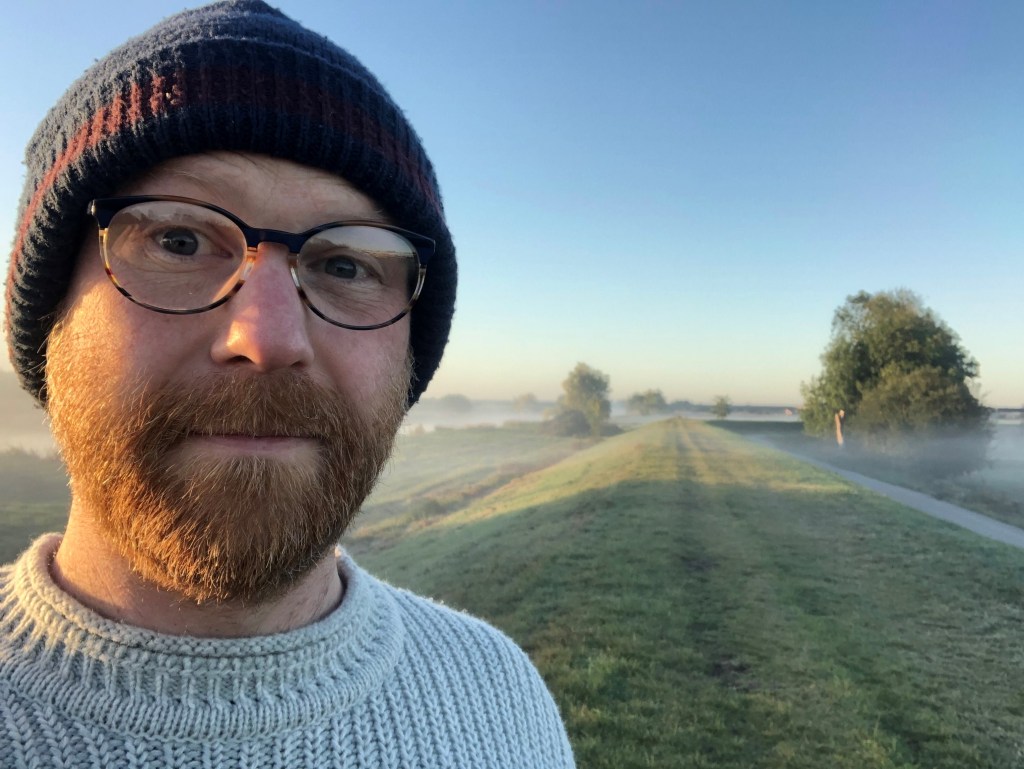
Like many people, Andrew started writing during the Covid lockdowns. He is interested in exploring the unusual occurrences taking place under the surface of everyday situations. Andrew lives in Cambridgeshire with his family where he works as a part time music teacher.
Kampala Rain
It was usually dry in Kampala but when the rains did come, they were heavy. Even after two years I still found it difficult to judge how much time there was between the skies clouding over and the arrival of those fat penetrating drops. So, while others sheltered under narrow shop fronts, splintered cupboard doors, or broken umbrellas; I could often be observed steadily squelching home.
This one rainy day I wanted to tell you about, I had been sent by the boss to the mall for emergency Nido, that’s powdered milk, widely available in every single shack shop across the city. But the boss really disliked those shack shops. Even if someone else (me) was to collect the item, he said it must be purchased from the mall some five miles away. He did not trust the street vendors, he said, as they sold shoddy produce and overcharged internationals like us.
I might have proposed that supporting a small local business would seem to fit our organisation’s grassroots approach, offering “a hand up not a handout,” much more than giving money to a pan-African supermarket chain. But instead, early that morning, upon receiving one text message: “Milk ASAP. Emergency,” quickly followed by a second: “Thanks,” I simply left my place in haste to collect the item without question.
Living next door to the boss I knew him to be at home that morning. With ease I could see the upstairs balcony from where he regularly held his morning meetings and meditations. As I locked my front door, I could smell the fresh coffee and pastries collected from that Dutch bakery. Could he not have purchased milk powder when he got his croissants?
Please don’t think that I was simply at home with nothing to do but wait for errands. No! I did actual work for the organisation as well: mostly administrative tasks on an ancient, shared desktop and a bad-tempered printer.
All members of the team were supposed to book a slot on the clipboard which hung on the door of the computer suite/utility room because of this one afternoon I had gone in to edit some dull training material we used with teachers in rural parts when the boss strode through the door, papers in hand, and eyed me coldly.
“It’s always best to ask,” he said. Passive aggressive, I thought.
That’s why the clipboard was introduced. And probably why I found myself doing more errands than administration, like this morning I wanted to tell you about.
The walk down to the main road was cool and quiet. It was a grey morning so the usual stickiness under the arms and on the back was avoided. A shrill clarion call as a pair of ibis launched from a rooftop. After that, there was no other sound for some minutes. Just my footsteps on the dull, red earth.
Before long I reached the trading centre. Mattresses piled high. Airtime for phones. Ground nuts raw, pasted or roasted. Crates of bottled Coke and Krest. Chapatis fresh but fish fresher, caught that morning from the lake. Printing and scanning for five hundred shillings. And a weave for your hair or braids.
As I passed, there was a delighted cry of “Muzungu!” from raggedy children who giggled and gazed wide-eyed, hardly believing the sight. That’s how it was in those days. Now, no one cares. But then, there weren’t so many of us around and one’s presence carried weight.
This type of attention was fine when, for instance, a smiling security guard would keep another driver waiting so that you could take the free parking space. But not as fine if you had, say, facilitated an event on the outskirts of the city and, leaving at sunset, hurried through a sparse trading post, aware of hidden eyes and the air suddenly heavy with menace. Then you understood the precariousness of the cross-cultural game you had stumbled into, the rules of which no one had thought to share. Yes, then you knew what lay beneath the facade of deference you depended on each day.
But such truths – enough to utterly dismantle any ostentatious dreams of making a difference, and bring about the most existential of crises – were best ignored. And, in any case, they could be easily forgotten in the enthusiastic welcome of a friendly boda driver.
“Yes, my friend,” they would say. “How are you? How is the U.S.? The UK? Ha! Arsenal will teach Spurs a lesson they will never forget on Saturday!” And then, beaming, assuring you that your work was important, that you were needed: “Come, I will take you!”
Thank God for boda drivers then!
Bodas are motorcycle taxis. In the city they are everywhere. Drivers cram onto a small piece of road waiting for customers. This, their stage, is operated by one senior driver who monitors the amount of bodas in any one spot. With prices higher than the matatu – a fourteen-seater minibus taxi – most passengers climb on the back of the bike for just a short distance – to carry them uphill for that tiring, final part of their journey.
Of course, back at home bodas would never work. The rush of speed and sound that weaves and winds around all other vehicles, daring them to challenge would, I think, be frowned upon.
Squeezing through the narrowest of spaces with a bed frame, baby or box balanced on the back, they then mount pavements and splash through streams left by leaking water pipes, or create shortcuts that run off-road round rural shacks and sickly chickens.
And then there is that moment when, riding as a passenger, you are taken by surprise at high speed by a car approaching from a side road and come crashing to the ground. You stand, dazed and damaged, unsure of protocol. Do you still have to pay? Hovering stupidly beside the smashed-up remains of a two-wheeler, you are waved away by the crowd that inevitably forms around the irate driver: “Muzungu, you go. Just go!”
No, it would not work at home.
I had good relationships with a few of the local bodas at the stage on the corner by the trading centre. I even had a couple of phone numbers I could call to be collected and delivered door to door. But this was no use before midday and as it was now only just past nine, I took a walk down the hill instead. As expected, only one or two were waiting, and no one familiar. Too early. So, I hailed a driver, giving my destination as I climbed on the back, and off we went.
Out on the main road, he told me over his shoulder that his name was Bosco. He wore a handlebar moustache, and drove an old bike with a torn seat, speeding too fast through the junction at Kabalagala. He complained at the chorus of angry horns, “They don’t respect the boda.” And he reeked of alcohol. Gripping tightly to both sides of the seat, I wondered if he was at the stage so early because he had not been home.
He left me at the mall which meant I would have to employ one of the bodas who always charged extra to get home. But that was OK. While I did enjoy the adventure of a drunk-tired boda with no helmet, once a day was enough. I hurried past the guards who never checked me and completed my task in the supermarket.
Not long after, I stepped out with my can of Nido in a carrier bag and saw how the sky had darkened to a threatening grey. The storm’s imminence momentarily quieted the city, and then it was time to move.
I rushed through the car park to the stage trying to make eye contact with a boda. Any boda. No one was biting. Usually, I would be rushed by a million beeps and raised arms and “Yes?” but not now. As some trotted over to take shelter under a decorative palm tree scene built against high white walls, I approached a driver still seated. He looked at me from under a precariously balanced, sideways leaning helmet as I named the destination.
“But the rain is coming,” he said, eyes darting upwards, and prompted by his words, the drops began to fall, striking metal of abandoned bikes like hammer on nails.
“How much?”
He exhaled, “Eh!” and named a price almost double that which I had paid from home. Fine. I climbed aboard and he hung my shopping bag from the handlebars.
“We go?”
“Let’s go! Gende! Quickly!”
Of course, the traffic worsens when the weather is bad, and we joined a swarm of unruly machines. Left; right; on the pavement; stop; start; each driver inventing their highway code. Until all stopped and opposing groups of fifty or more bodas faced-off at a four-way junction held stationary by police. Behind them, beat-up Corollas and puffed-up Landcruisers became unexpected peers, made equal in the waiting.
Upfront, pairs of eyes watched pairs of officers who marked territory in navy windbreakers. Everywhere, two wheels, two passengers, sometimes three. And the hum of two hundred engines was nothing against the opening of the heavens. One, then two bodas broke free from the right, daring to cross no man’s land. One skidded, almost falling to the ground, before regaining composure and speeding away towards the industrial area.
Left and right lanes were released; a surge of power made waves knee-deep that swashed those of us still stationary. With no jacket, my clothes became my body in a single sodden, dripping mess. Intimately ahead, the driver’s waist invited my arms, simply for comfort and warmth. But I kept my grip on the icy metal either side of the seat and watched streams run down his anorak, finding a home on my legs. The bike’s little engine sputtered and popped.
Then we were released. Bodas fanned and covered the road leaving four wheelers frustrated behind. Down the straight. Avoiding potholes. Crashing through potholes. Unsteady over the railway line. A tight left turn. Then the traffic lightened. The rain did not. It pummelled us without mercy.
As he drove, the rider turned back. “It’s too much!” he said, stealing a look at the road ahead when the front wheel slid. Straightening up he turned his face again, “My place is just here.”
There was no argument. I just said, “OK.”
He turned into Kibuli. Red rivers ran, making a foamy rapid that covered the road. He changed gear, fighting against the tide, his bike betrayed as pitifully powerless. Then, below us, a grey block of rooms with a long courtyard in between. There was no one around. Obviously. The driver stopped the bike, we climbed off, slid down the bank and ran to his door.
Inside, we stood, dripping. The room was a square with a curtained-off area. There was a pile of something against the wall on one side with a keyboard on top, and some simple food items stored in a plastic tub.
“My God!” he laughed. “That rain is too much!”
I agreed and wiped my face with wet and wrinkled hands. Hair sticking frustratingly to my forehead, I envied his fresh-looking trim which in any case had been protected by the helmet.
He said, “But we can wait here a bit, then I’ll take you.”
The driver removed his anorak and tossed it near the door where he had already placed his helmet. He started to undress and ducked away behind the curtain from where I could hear his voice: “I have clothes for you here. You come.”
Now, I am not sure how you imagine you might react in such a situation. I would certainly have told you beforehand, that never in a million months of Mondays was I going behind that curtain. But all the same, and in the spirit of what happens in Kibuli stays in Kibuli, I peeled the clothing from my shivering and sticky skin and stepped behind that curtain.
Before a foam mattress and a folded blanket, he was already changed and dry. Laughing again – “That rain! It caught us!” – he handed me jeans and a T-shirt and told me I should return the items when we reached my place.
“OK,” I said.
Quite suddenly he was before me.
I, down to just a loose-fitting T-shirt, and crouching undignified to wrestle a stranger’s jeans over my water-filled shoes, felt something though I don’t know what. My heart rate increased, but not through fear.
I stood.
His expression was impossible to read; brown eyes deep and intense. I noticed his clipped moustache and a birthmark on his cheek.
And then, behind a make-shift curtain in a grey room in Kibuli the boda man kissed me.
He leaned in, and I responded.
An event free of passion or embrace, our bodies did not touch. And yet it was heady and potent. I felt nothing except the warmth which began deep inside and rushed to fill every part.
Then it was over.
He broke away and said, “You can change now, the rain is almost stopping.”
I dressed, we stepped outside, and he padlocked the metal door. The rain was easing; over as suddenly as it had begun. While I struggled up the muddy bank, he dried off his bike with a rag.
Riding on the back through flooded streets, I wondered. Perhaps he had just wanted to know. Perhaps I also wanted to know. Simply to experience it. Then the thought went the way of the leftover rainwater which soon, if it had not sunk deep in the soil, would evaporate.
At home, I ran inside to change once more, and then back down to the gate where the driver was waiting.
I handed him his clothes with a soggy note of shillings, a great deal more than we had agreed earlier, and his eyes became greedy.
“You know,” he said, as sly as a gecko watching a fly. “I don’t have change.”
“It’s fine.” It was fine. I turned back towards my gate. “Thank you for the clothes, that was kind.”
“Ha! Next time!” He revved and was gone.
Back inside, I had four missed calls from the boss. It is rare to hear one’s phone ringing when riding a boda. That is why drivers often lodge phones inside their helmets. I searched around me one way and another then remembered. The milk! I had left it dangling on the handlebars.
Fantastic.
The phone rang again.
Ignoring it, I ran straight to the big house to explain and found Rose mopping up a trail of muddy footsteps on the cold tiled floor. Rose was the maid in those days. Sometime later, I don’t remember when, she found herself pregnant while unmarried, and quickly also found herself employed as a maid no longer; dismissed without pay.
I greeted her and said, “Can I go up to see Bwana?”
She giggled. Bwana means Lord. “You’ll find him there.” She waved me to the living room.
I found the boss and his wife with a man dressed smartly who stood as I entered. Returning to his seat, the trousers rose high above his creased and shiny shoes. His hair was longer than you would usually see in the city, neat but un-oiled, and his beard was a little unkempt. I suspected he was from the village. A Study Bible and notepad beside him suggested a Pastor.
“Ah, good morning,” said the boss’s wife cordially. “We’ve heard from Abraham here that they need a two-day training for teachers up near Mbale.”
“Namabasa,” Abraham interjected, placing his hands together in apology, and disappearing back into the chair.
“Yup,” said the boss. “So, you’ll leave tomorrow. Abraham will be back here early -” he marked the word with a cautionary glance in the man’s direction, “- and you can travel together in the truck. The stuff is in the garage ready to load. You will probably want to get that done today.”
I told him that was great news, and it was an excellent opportunity and that I was more than ready to go up-country as a change to my usual administrative tasks and errands. Not that I begrudged those things, I said. Not at all.
Then I confessed to not yet having got the milk.
“Milk?” He looked confused, irritated. “What milk?”
The End
 impspired