

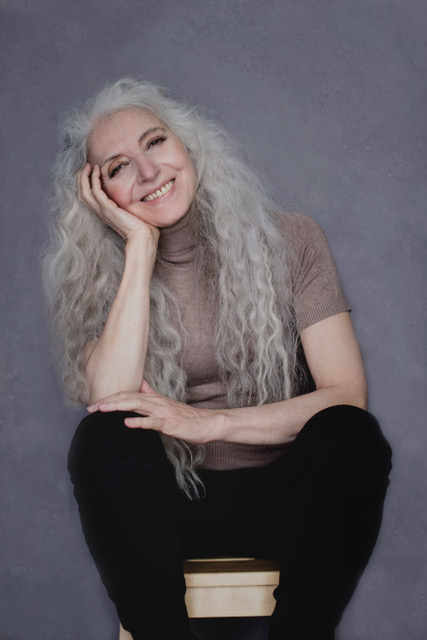
Alex LR is a former university lecturer with a PhD in Art History and Archaeology from SOAS, University of London. A fashion activist committed to diversity and inclusion and greater visibility of older women, Alex has blogged, written for magazines and journals and is the author of books on fashion published by Bloomsbury and Rizzoli New York. She is currently working on a collection of short stories.
Twitter: @alexb244
Instagram and Thread: @alexb244
Chiqui’s smock
I was five years old, almost six. It was my first day at primary school and I was incredibly excited, I could hardly wait to embark on this new adventure, for which I had been meticulously preparing for weeks. At the time, we lived on the outskirts of a coastal city in southern Italy, on the Tyrrhenian Sea. My father, an engineer, had been transferred from Milan by the company he worked for.
Our home was a charming villa with a well-kept garden, just 400 metres from the sea. A small path and a rather steep staircase led to a secluded pebbled beach that felt like it was ours alone—no one ever seemed to come that way, especially in September. To the locals, September marked the beginning of autumn and the end of summer vacations and sea bathing activities, as school and work beckoned.
My mother revelled in the early autumnal weather, warm and sunny – a stark contrast to Milan’s chilly climes. She spent her days lying on the semi-deserted beach, where only a few dedicated sunbathers would come at lunchtime from the nearby town. She indulged in leisurely, lengthy swims, while a stout local girl, barely eighteen, took care of domestic chores and kept an eye on me and my younger sister. When she was not basking by the seaside in her bikini, my mother wore pastel-coloured cotton dresses and high-heeled, dainty sandals, and drove in her convertible Alfa Romeo Giulietta to the town centre, to shop or meet other stay-at-home mums, wives of my father’s colleagues.
Sometimes, donning a silk scarf wrapped around her head and tied at the back of her neck and a pair of dark sunglasses, she took the car along the scenic road that goes to Sorrento and enjoyed the cool breeze on her face. She drove too fast for my father’s liking and he always remonstrated with her, calling her ‘reckless’ and forbidding her to take any of us girls along during such excursions. She always laughed it off, as in reality she was a very conscientious driver, but she complied with my father’s prohibition. I suspect, in hindsight, she never meant to take us along, it was her me-time, and Ada, our girl, did a good job entertaining us, for which she was handsomely paid.
Whereas the local women of our provincial town had already switched to jumpers, court shoes and stockings, my mother continued to wear sandals and light tunics well into early November. With her bare, sun-kissed long legs, and her bleached blonde hair, she always captured the spotlight. I often secretly wished she were more like all the other mums, I hated the attention she drew; everyone seemed to notice her, asking whether she was, by any chance, the actress they had seen in the movie ***. She would reply, feigning surprise, “Oh my goodness, you saw that? I left acting behind ages ago, for the girls, you know.” This only piqued further curiosity because she was rumoured to have mingled with famous film stars in Cinecittà – or so everyone was led to believe.
I was school-ready, wearing my uniform, consisting of a grembiulino, a white smock ironed to crisp perfection with an embroidered detachable collar and a shocking pink floppy bow, tied at the neck by my mother with great flare. The ensemble was completed by white cotton ankle socks and glossy black shoes. I carried a brown satchel containing a lined notebook, a pencil case with multicoloured crayons, a blue biro, a rubber and a sharpener. I loved the leathery smell of my satchel and cherished the newness of it all. The smock was my pride and joy. It fell just below my knees, with lovely pleats at the front, and hidden side pockets. The carefully embroidered buttonholes and heart-shaped buttons were my mother’s stylistic touches.
We walked to an imposing old building, one of the largest primary schools in the entire district. My mother held my hand tightly, so that I would not get lost in the crowd. On the first day of term, confusion and disorder reigned supreme. Several people – parents, children, caretakers, classroom assistants – were milling around, while teachers were lining up the older pupils, who quickly vanished into their newly assigned classrooms.
For us infants it was utter chaos. Girls were being ushered away from boys and directed through separate doors, while mothers – and the odd dad – continued to bustle in with their children. My mother’s grip was still firm on my hand, but I could not wait for her to leave me there on my own. Some girls were sobbing and clung to their mothers pleading, ‘No, no, please, don’t go!’ I looked at them scornfully. Such babies! I felt grown up and important.
My mother struck up a conversation with a petite, attractive woman wearing a green, long-sleeved cotton jumper with black chevrons, matched by a black pencil skirt. She too wore high heels, like my mother. Her little girl, Cecilia, had her raven hair arranged in two thick braids. I envied her luscious tresses and yearned for her long curls, so unlike my light brown bob – my mother thought shorter hair was more manageable for young girls.
In all that clamour, our mothers were trying to figure out which classroom they had to deliver us to. Suddenly, I let my mother’s hand go and darted forward. “Chiqui stop, that’s not your classroom,” she called out, swiftly reaching for me. I halted and retorted sharply, “My name is Amelia. Don’t call me Chiqui.” Both she and Cecilia’s mother, close behind, exchanged glances and burst out laughing. Eventually, they managed to find the right classroom, after asking another mother. Our teacher, a jovial and plump lady, greeted us at the doorway with a list in hand and a big smile on her face, “This is Chi… sorry, Amelia, and this is Cecilia,” said my mother, handing us over to the teacher. Then she left with her new friend, both of them waving goodbye. My first day at primary school was a turning point: from that day on, my nickname Chiqui – given to me by my mother because as a toddler I had been fond of Chiquita bananas – was never used again. I thought it was far too babyish and refused to acknowledge it.
Fast forward several decades. December 2015: my mother was hospitalised once again. At eighty-seven she had teetered on the brink of death for over two years. She resided in Milan under the care of my younger sister Sara, battling with dementia and other afflictions. A mere wisp of the vibrant woman she had been, she had diminished several inches and had become skeletal. She had lost all her teeth and refused to wear dentures; her hollow, sunken cheeks made her resemble the hook-nosed Befana witch of the Epiphany feast, feared by children all over Italy.
During my visits from Berlin, where I had followed my German husband, whom I had met in Rome at the FAO headquarters fifteen years prior, my mother would enquire of my sister “Who is this?” then adding, “We must take good care of our guests.” It made me laugh, but the sting was sharp. Once, fresh from the airport and seated at dinner, I began to reminisce about my father, long deceased – he was killed in a car crash soon after I left Italy for Germany. Out of the blue, my mother turned to me “And when did you meet my husband?” using the Italian polite form, Lei, to address me. Disconcerted, I fled to the bathroom, to hide my tears.
The calls from my sister became an ominous pattern; her voice, laced with panic, would inevitably convey the same message: “She has been hospitalized again. I think she will not make it. Please come as soon as you can.” I was reluctant to drop everything and go, and yet I knew that, as the eldest daughter, filial duty dictated I should be at her bedside. I experienced each time an uneasy feeling of déjà vu, as my mother clung tenaciously to life. I found myself secretly hoping that each goodbye would be our last – mercifully for her, for us. Yet, time after time, she defied the odds, rebounding from the brink of death to be discharged days later, with my sister dutifully escorting her home once more.
On that freezing early December evening, my arrival delayed by inclement weather, I met Sara just outside the hospital ward. Her eyes, brimming with tears, sought mine as she whispered, “This is it, Amelia. She won’t survive until morning. We’re about to become orphans.” I almost laughed; Sara was being so utterly melodramatic. All along, she had clung to the absurd notion that our mother would be everlasting.
Steeling myself, I entered the private ward – my sister had insisted our mother should be on her own and get the best possible medical care. We could not really afford it, but Sara had been adamant and my credit card debt was increasing steadily. I looked at my mother with dismay: her body was enveloped in a labyrinth of tubes. Who was this wretched woman? Was she really my elegant and witty mother? I struggled to reconcile the reality of what I saw with my recollection of her.
She appeared to be resting. Suddenly, her eyes fluttered open. She had the most beautiful aquamarine eyes, neither I nor Sara have inherited them, to our chagrin. “Chiqui,” she said softly, “there you are. I told you not to run. You must always hold my hand.” Then a rasp, a silence. She was gone.
The next few weeks were hectic. I had not been around when my father was killed in that horrendous car crash, my husband and I were away in Japan at the time. I had managed to reach Milan only after he had been buried, my mother and Sara had sorted everything. Now I wanted to be there for my sister who was absolutely distraught. I took time off work; the advertising company I worked for in Berlin was very understanding, “Come back when you are ready”, they said. My husband wanted to join me in Milan but I told him he should not; I preferred to be on my own. I knew Sara would not have welcomed the presence of someone she regarded as an outsider. She was like that, my sister, very private; her idea of family did not seem to include partners.
Soon after the funeral, Sara and I began to look through our mother’s possessions, to decide what we should keep. In her wardrobe there were very chic dresses from way back, many of them by famous labels, which she had never been able to part with and would now be regarded as vintage. Neither my sister nor I had her tiny waist, many of those clothes did not fit us, thus the pile of things to be given away, possibly sold, kept growing. As for the shoes… every time we tried a pair on, we conjured up Cinderella’s stepsisters attempting to squeeze their large feet into the glass slipper. “Unbelievable” Sara blurted out “How could she, tall as she was, have such tiny feet?” She was especially disappointed that a pair of beautifully crafted high heeled sandals, with delicate straps, were too short and narrow for her feet. “Wait, I remember these” I said “Did she not wear them when we lived near Salerno? They still look pristine.” But Sara was not listening, she had found a small suitcase hidden at the back of the large mahogany wardrobe and was busy opening it. There, among various pochettes and scarves, was a precious Hermès which Sara had always lusted after. And, tucked away at the bottom of the case, neatly folded in a white cotton bag, was my primary school smock, with the pink bow pinned on it and a note in my mother’s neat handwriting saying ‘Chiqui’s first grembiulino’. How strange that she should have kept it all those years! And again that nickname, Chiqui!
“You were always her favourite,” said Sara, when she saw the note, unable to hide a pang of jealousy. “Of course not” I replied quickly, to soothe her, adding, not very convincingly, “She probably decided to hang on to it because she must have wanted you to wear it, except that when you went to primary school, a grembiulino was no longer a requirement. She must have forgotten all about it.” Sara accepted my explanation, there was no point in dwelling on the matter. “I will take it” I said, the smock already in my hands “Keep everything else and dispose of what you do not want.” That settled it.
It has been six months. I have kept the smock stored in its cloth bag on the top shelf of our walk-in closet at our home in Berlin; I have not yet decided what to do with it. We have no children and anyway, no one uses that kind of smock now – not in Germany and not even in Italy. My husband found it just the other morning, while searching for his spare trainers, and the bag fell on his head. “What’s this?” he asked. “And who is Chiqui?” he continued, picking up the note that had dropped to the floor when he opened the bag.
“Oh that…it was mine when I was little. They used to call me Chiqui back then” I answered, taking the smock from him and putting it back in the bag, with the note securely tucked into one of the side pockets. “Chiqui? I like the name” he said, grinning. I adore my husband’s toothsome smile, he could easily be in a toothpaste commercial. As I work in advertising, I always think of such things, it is an occupational hazard. “Nein, bitte. Ich mag diesen Spitzname nicht.” German has grown on me, I often use it rather than English, which we both speak fluently. I do not even think in my native Italian, anymore. “Chill out, Amelia, I really did not …” he started. I kissed him, then said, still embracing him “Let’s have breakfast, I am starving.”
No one can ever call me Chiqui. Only my mother.
 impspired