

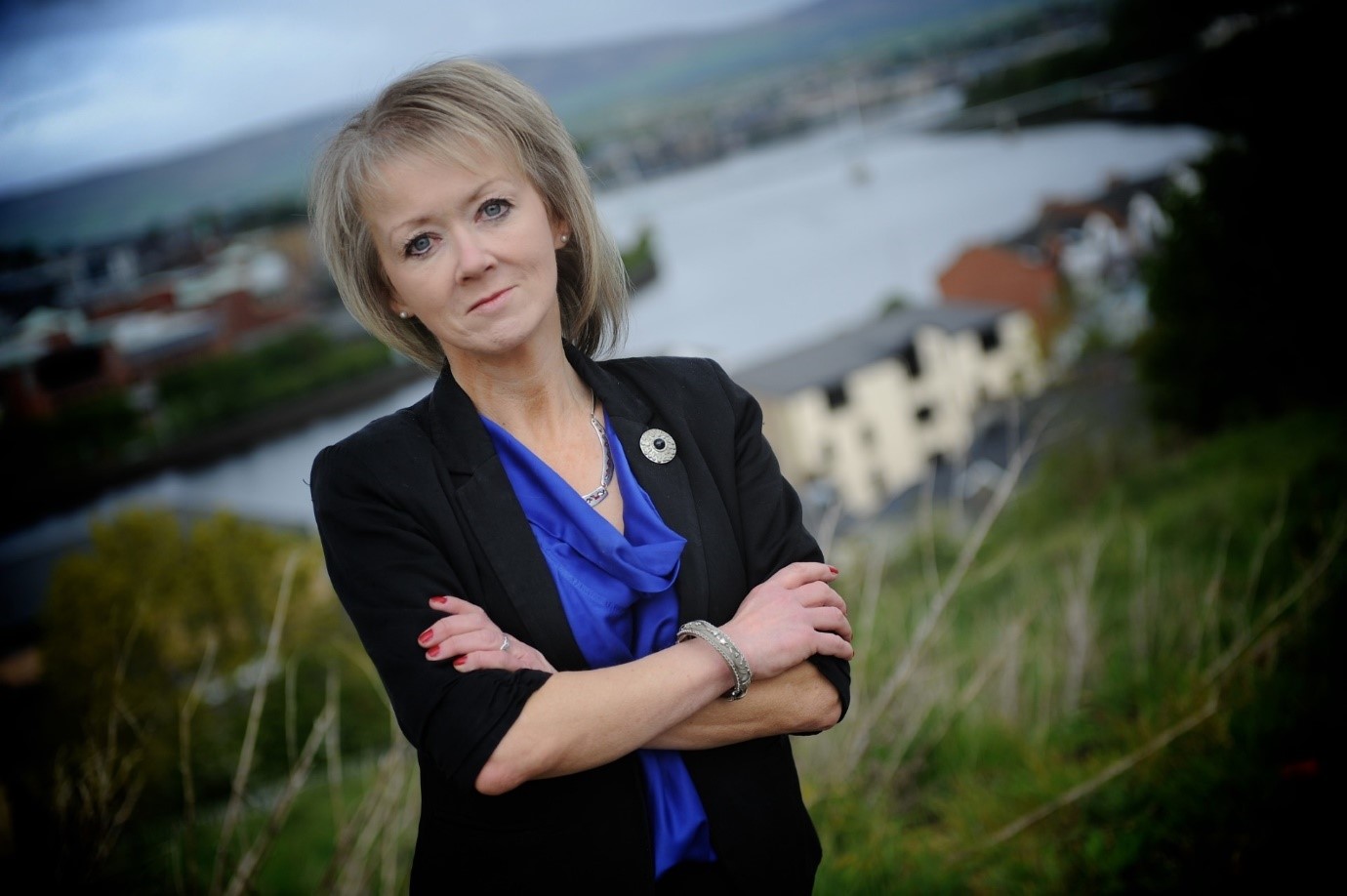
A BBC staff journalist for twenty years based in Northern Ireland during the conflict, Felicity McCall is a writer and broadcaster. She has more than twenty published titles, thirteen plays staged professionally and four screenplay credits. Genres include young adult fiction, literary fiction, short stories and memoir for Little Island, Guildhall Press, Penguin and Blackstaff. Her theatre life saw her founding and running three professional touring companies and acting for stage and film, as well as co-founding the multi-disciplinary group, Literary Ladies. Career awards include the Tyrone Guthrie award for stage and screenplay, a best Heritage project UK Big Lottery award, eight Arts Council individual awards, two Meyer-Whitworth nominations, and two Irish theatre awards. A professional member of the Irish Writers Centre, she mentors and facilitates individuals and groups. A lifelong trade unionist, she was the first woman to co-chair the Irish executive of the National Union of Journalists, and is a governor of Oakgrove Integrated College in Derry. Defining herself as an artist/activist, she has been privileged to work with miscarriages of justice, trauma and abuse survivors and aspires through her writing to give a voice to the voiceless. She is now beginning her third year in the post of Royal Literary Fellow with the London based Royal Literary Fund.
Changed
Today, Mammy and I are going to the seaside, the seaside of her childhood. I am so excited on her behalf when I hear she is well enough to be included in the outing- provided I am there, too. I count myself privileged.
We wait outside while the minibus is loaded with its fragile passengers. We will be among the last to get on as Mammy’s wheelchair has to be bolted to the floor. She can only be moved by hoist. She has forgotten what her legs are for. She has forgotten most things. I had thought my heart would break the day she forgot me. It broke the day she forgot my da. Not just his name, but every memory built over more than sixty inseparable years. She is getting restless. I tell her again that we are going to the seaside. She smiles. Wherever Alzheimer’s has taken her, I am so grateful that it seems to be a happy place.
I am so inexpressibly grateful that we are getting this day of unlooked-for happiness. A last visit to the sea. Together. As the Atlantic swells into view, I search her face for any flicker of recognition. I lean across to speak loudly into her good ear, telling her that we’re nearly there, not long now. She has little patience. Is it death she is hurrying towards? She may or may not hear, she may or may not process what I am saying. Still, that smile. The cruelty that is Alzheimer’s cannot steal it.
The bus pulls in on the promenade. I look around for any sign of a care home but no, we are going to a regular restaurant. Half the ground floor has been reserved for our party. There is fish and chips, or chicken and mash. The staff have chosen chicken and mash for Mammy. The mushy mixture she pushes away. I order fish and chips for myself and her eyes twinkle as I surreptitiously break up chips and put them on her plate, cut off small chunks of crispy golden batter. Her enthusiastic appetite sets her apart, causes comment. The bar is open and I get her a white wine and she clutches the fragile stem and sips it, appreciatively.
I reminisce about the seaside, how she and Da took me there, how, in time, we took my daughter. How, as a child herself, her own daddy was wheeled along the promenade by his nurse as she skipped behind him.
‘The wallpaper was different.’
The table falls silent.
‘The wallpaper was different,’ she announces, confidently. ‘None of this wooden stuff. It was proper wallpaper.’
‘And the big feeds were upstairs.’
‘But your daddy couldn’t get upstairs because he was in a wheelchair,’ I prompt.
‘We had our ice cream down here,’ she continues, ‘and a girl like that one brought it to our table- like they did there now.’
‘You’re getting your ice creams in a wee while,’ one of the nurses promises.’ But first we’re going to sit outside.’
I buy a second glass of wine while she is wheeled out, and pull up a chair beside her. She takes my hand. It is a truly beautiful day, not too hot, the sea and sky a rich, clear blue. The sun warms us.
We sit in companionable silence. There is no need for words. Her eyes follow the roll and crash of the waves, and she smiles. With her mouth, and her eyes. And, I hope, her heart. I feel a huge swell of unconditional love for this remarkable woman who gave life to me.
Tears well up as I hold her hand tighter.
‘That’s new. And I think it was over here.’
The cafe? Somewhere she stayed? It doesn’t matter.
A nurse who overhears us, marvelling at this sudden recall, says that when we get back she will look up old photos of the area in the 1920s and print off a selection. I agree happily, knowing that the catalyst will not be found on a printed page. It is here, in the salty tang of the sea air and warmth of the June sunshine, in the crispy golden batter and the ice cream which has just arrived and, joyfully, has raspberry sauce on top. It’s in a little waxed dish, not a cone, and the spoon is small and plastic.
She grins. And I wish I could hold this moment forever. I wish her life could end here, now. I wish she could avoid the painfully slow path of deterioration that lies ahead. It is so undeserved. I wish I had that power.
I take her hands to wipe away the stickiness. They are cold.
‘Cold hands, warm heart,’ I say to see if she reacts. She smiles.
‘It’s changed.’
‘It must have, it’s been ninety years since you first came here,’ I joke.
‘The wallpaper was different.’
There is a hint of the mischievous three- year-old’s smile flickering across worn features and sagging skin.
She will not remember, tomorrow. She will not remember by the time we get back to the home. She is tired. Her eyelids droop. She will sleep away the journey.
My eyes search the promenade. Maybe, somewhere, I might catch the ghost of the dignified man being wheeled along the promenade while the little girl he can no longer look after, who is his life, skips along beside him, swinging a red tin bucket, and laughs because the seaside is the best place in the world.
Human existence must end and buildings crumble but there will always be sunshine, and frothy waves, and fish and chips and ice cream, and the vital pulse of life itself. In that moment, I know that the world can be unbelievably good and that I will hold this memory within my heart, forever.
Mammy looks at her watch. She cannot tell the time now, but habits remain. She will thank everyone for taking her out and say she had a lovely time. Manners are for life.
‘I think we should get going now.’
Always, now, impatient.
‘We have to wait for the bus,’ I remind her gently, but of course she has no idea how we got here or where we are going back to.
I don’t want to leave. I don’t want this magical day to end. But she’s right – it is time.
Her gaze remains fixed on the sea, and wherever she has gone to, it is good. I have no need to share it. It would be an intrusion.
She is still looking back at the shore as she is pushed towards the minibus.
‘So, was it all changed?’ the nurse asks her.
Clouded eyes, once so vividly green, meet the nurse’s and then, smiling, turn to meet mine.
‘It hasn’t changed. The sea. The sea never changes.’
 impspired